
You and Peptides Research · ~11 min read
How Peptides Are Made — A Manufacturing Deep Dive
From Merrifield’s 1963 resin bead to flow chemistry, recombinant DNA, and modern hybrid plants
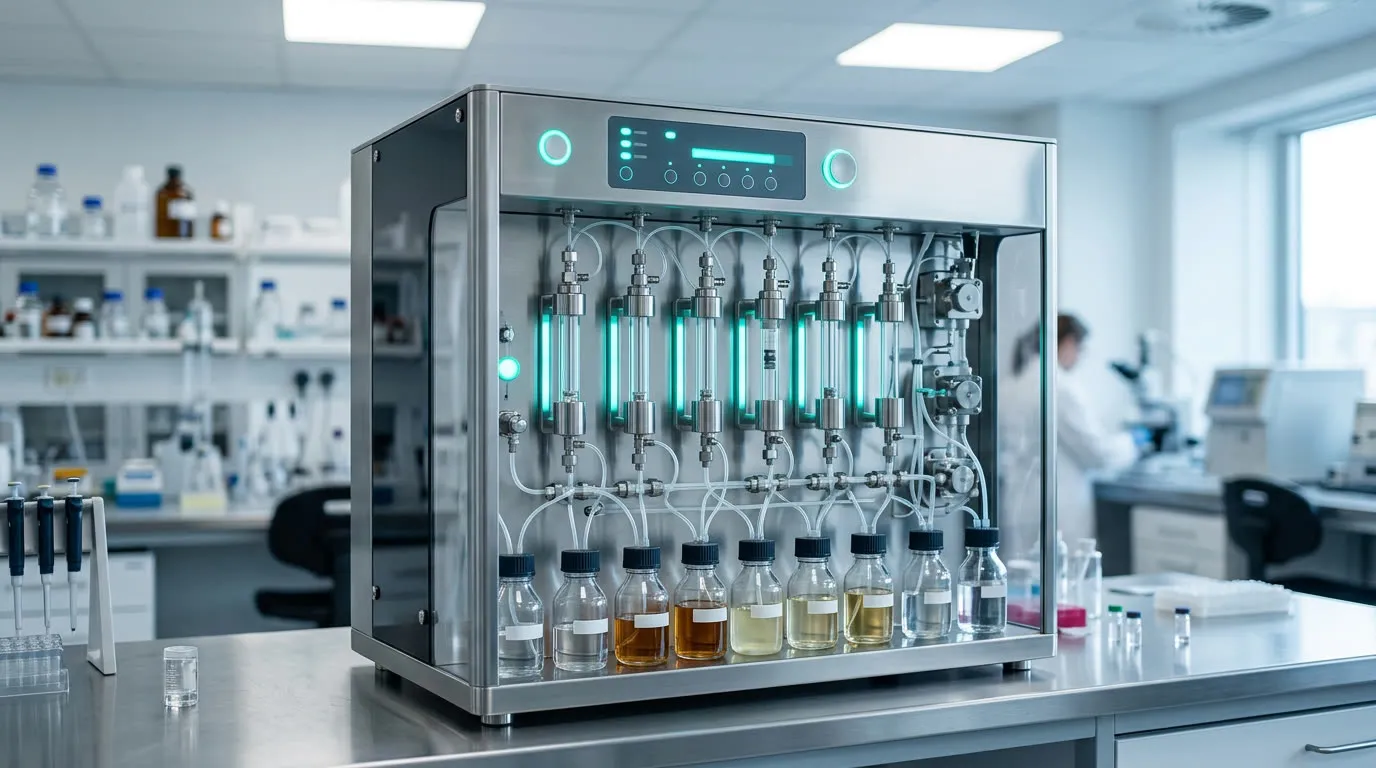
Pre-Merrifield: why this used to be impossibly slow
Until 1963, building a peptide chain meant repeating four steps for every amino acid you wanted to add: protect the right reactive groups, couple the new amino acid, deprotect, and purify. The purification step is what killed you. Each round of synthesis produced a soup of products — the desired chain plus side products from racemization, double-coupling, and incomplete reactions — and the only way to move forward was to fish your target out of the soup before doing it again.
For a 5-residue peptide, this was tedious but tractable. For a 30-residue peptide, you might lose half your material at every coupling step. Half-yield over 30 cycles leaves you with one part per billion of your starting material. A complex peptide could take a graduate student two years.
Merrifield’s insight: anchor the chain, rinse the reagents
In 1963, R. Bruce Merrifield published a five-page paper in the Journal of the American Chemical Society titled "Solid Phase Peptide Synthesis. I. The synthesis of a tetrapeptide." The key idea was simple. Don’t purify after every step. Anchor the growing peptide chain to a bead of insoluble polystyrene resin. Excess reagents and side products can then simply be filtered off and rinsed away after each coupling, while the desired chain stays put on the bead.
The yield benefit per step was about 99.5%. After 30 cycles you still have ~86% of your material — instead of one part per billion. Synthesis time collapsed from years to days. Merrifield received the 1984 Nobel Prize in Chemistry for it.
Modern SPPS: Fmoc, microwaves, and flow chemistry
Today’s standard is Fmoc-SPPS. The Fmoc group (9-fluorenylmethyloxycarbonyl) is a temporary protecting cap on each amino acid’s amine that can be removed with a mild base (piperidine), avoiding the harsher acid conditions that Merrifield’s original Boc chemistry required. Fmoc made SPPS gentler, more compatible with side-chain modifications, and dramatically more reproducible.
Two more upgrades reshaped the field. Microwave-assisted SPPS uses controlled dielectric heating to drive each coupling cycle in 2–4 minutes instead of 30–60. And flow chemistry, pioneered by labs at MIT (Pentelute) and Cambridge (Cooper), pushes reagents through a fixed-bed column at high pressure — letting researchers synthesize 50-residue peptides in a single afternoon.
When chemistry isn’t enough: recombinant DNA
Some peptides — especially the larger ones, like full-length insulin (51 residues, two chains, three disulfide bridges) — are easier to make biologically than chemically. In 1982 Genentech and Eli Lilly produced the first recombinant human insulin (Humulin) in genetically engineered E. coli. The animal-extract era ended.
The trade-off: recombinant production requires a fermentation plant, downstream protein purification, refolding, and disulfide-bond formation. It is far more capital-intensive than SPPS. But for proteins above ~50 residues with complex post-translational requirements, it is the only option that scales.
Hybrid manufacturing: how today’s drugs are actually made
Most modern peptide therapeutics use hybrid manufacturing. Semaglutide is a representative example. The 31-residue backbone is built by SPPS. The C-18 fatty acid side-chain attached to Lys-26 is added in a final solution-phase coupling. For other large peptides, the backbone is split into two fragments produced separately and ligated together at the end.
The economics are striking. SPPS now costs roughly $50–200 per gram for a research-grade peptide and ~$5–25 per gram at industrial scale, depending on length and modifications. The pharma economics around GLP-1 are not constrained by the chemistry — they are constrained by formulation, regulatory approval, and patent term.
- Backbone built by Fmoc-SPPS at ~99.5% per-step efficiency.
- Modifications (acylation, lipidation, cyclization) added in solution-phase steps.
- For 50+ residue targets: native chemical ligation joins two SPPS-built halves.
- For very large or post-translationally modified targets: recombinant production in E. coli or yeast.
Why this matters for what comes next
Generative AI design tools (AlphaFold3, RFdiffusion) can now propose entirely new peptide sequences. Whether those proposals can be tested at scale depends on the manufacturing pipeline. SPPS is general enough that almost any 30–50-residue sequence can be made within days. That tight loop — design overnight, synthesize tomorrow, test next week — is what makes the AI design wave plausible.
The next manufacturing frontier is automated, closed-loop systems where the synthesizer talks directly to the design model. Several academic labs (MIT, Imperial College, Princeton) have working prototypes. The bottleneck is no longer chemistry — it is interpretation of the resulting purity and biological activity data.