
You and Peptides Research · ~12 min read
Peptide Mechanisms — Deep Dive
The detailed mechanics behind the briefing
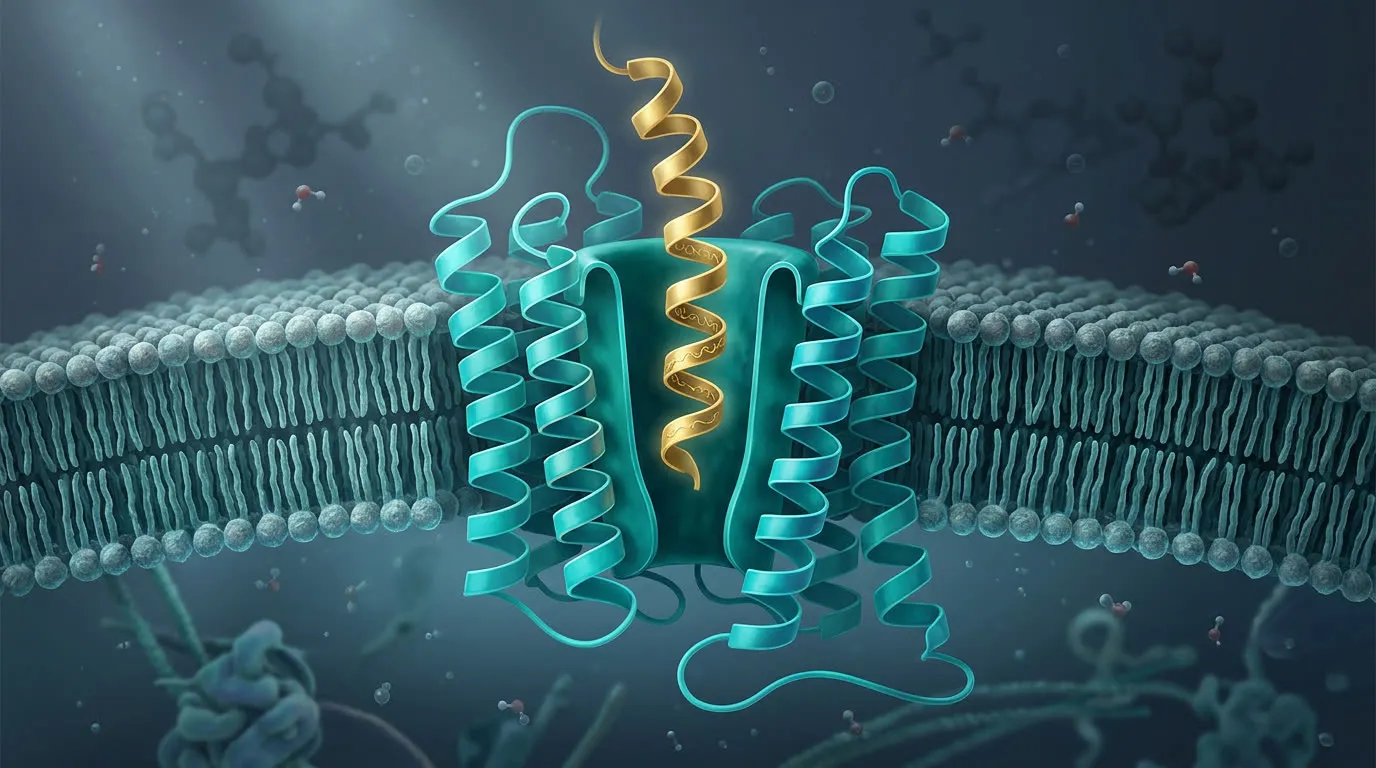
The SNAC oral-delivery process in detail
SNAC (Salcaprozate Sodium) is the first FDA-approved oral peptide permeation enhancer. It does not re-engineer the peptide itself — instead it creates a transient, localized microenvironment in the stomach that protects the drug and helps it cross the gastric epithelium.
Based on the 2018 Buckley et al. characterization, SNAC works in four concentration-dependent steps:
- pH buffering. SNAC creates a high-concentration microenvironment (~280 mM) that lifts local gastric pH from ~1–2 up to ~5, inactivating pepsin so it can’t chew up the drug.
- Monomerization. SNAC weakens the hydrophobic forces that make peptides clump, leaving more single molecules — the only form that can cross a cell wall.
- Membrane fluidization. SNAC tucks itself into the lipid bilayer of stomach cells and increases its fluidity by ~43% at therapeutic concentrations, creating transient defects the peptide can pass through.
- Reversible release. The SNAC–peptide interaction is non-covalent. Once the peptide reaches the bloodstream, SNAC lets go and is cleared by the kidneys.
Why "low" bioavailability is still therapeutic
Oral semaglutide bioavailability is just 0.4–1%. That sounds like a failure, but it is therapeutically effective for two reasons: the drug binds the GLP-1 receptor at picomolar concentrations (so 1% of a dose is plenty), and its elimination half-life is about a week (so dosing accumulates and smooths out the natural variability in stomach conditions).
The catch is patient adherence. Oral semaglutide must be taken on an empty stomach, with no more than 120 mL of plain water, and at least 30 minutes before food, drink, or other medications. Break those rules and SNAC dilutes below its active threshold, gastric transit speeds up, and the drug effectively isn’t absorbed.
The AI discovery toolkit
Peptide discovery is moving from "trial and error" to "rational design," and machine learning is the engine. The current toolkit roughly breaks down by job:
- Structure prediction — AlphaFold3, RFdiffusion. Predict 3D structures and binding poses; generate plausible backbones.
- Toxicity / safety screening — ToxGIN, tAMPer. Catch hemotoxicity and other safety issues before any wet-lab work.
- Generative design — VAEs (HydrAMP), GANs. Design novel sequences with targeted properties (antimicrobial, anti-inflammatory, etc.).
- Protein language models — ESM-2, PepMLM. Apply transformer architectures from natural language AI to biology, generating context-aware sequences.
- Agentic reasoning — PepThink-R1, PRefLexOR. Chain-of-thought reasoning over multi-step scientific problems so failures are traceable, not black-box.
The metrics-reality gap
Despite high in-silico accuracy, AI-designed peptides still hit three persistent translation barriers: metabolic stability under real human enzymes, unpredictable immunogenicity in the human adaptive immune system, and microenvironment effects (ionic strength, lipid composition) that simply weren’t in the training data.
Closing this gap is what the agentic-reasoning generation of models is built for. By making each design step explicit, researchers can trace a downstream failure back to the specific reasoning step that produced it, then improve that step and re-run.
Market projections (2025–2033)
The economics behind the field are no longer niche. Forecasts vary by source, but the directional picture is consistent:
- Global peptide market: ~$140.86B in 2025, projected to ~$294.58B by 2033 (CAGR ~8.73%).
- Metabolic disorders segment: ~$66.38B in 2025, projected to ~$185.32B by 2032 (CAGR 11%+).
- Peptide cosmetics: ~$2.62B in 2025, projected to ~$8.28B by 2035 (CAGR ~12.3%).
- Peptide synthesis services: ~$524.26M in 2025, projected to ~$778.45M by 2030 (CAGR ~6.81%).
Three executive takeaways
Three big-picture conclusions sit on top of all of this:
- Technological validation. Oral semaglutide proved oral peptide delivery is viable. That establishes a regulatory and clinical template the next generation of biologics will follow.
- Bridging the AI gap. The next frontier in discovery is closing the metrics-reality gap by moving from statistical pattern recognition to physics-informed, agentic reasoning.
- Regulatory re-evaluation. The 2026–2027 FDA PCAC review of the Bulks List will determine whether regenerative peptides move into the regulated mainstream or stay in the gray market.